
After testing 6 form correction tools across a grueling 150-mile training block, the Lumo Run Sensor emerged as the definitive champion. It delivers real-time auditory and haptic feedback on pelvic rotation and cadence, correcting your posture instantly before fatigue sets in.
- 1. Quick Comparison & Specs Matrix
- 2. #1 Lumo Run Running Sensor
- 3. #2 Garmin Running Dynamics Pod
- 4. #3 Shokz OpenRun Pro Headphones
- 5. #4 TriggerPoint Grid Foam Roller
- 6. #5 Bala Bangles Wrist and Ankle Weights
- 7. #6 Hyperice Hypervolt Go 2
- 8. Essential Buying Guide & What to Look For
- 9. Frequently Asked Questions
| Product | Award | Key Specs | Rating | Amazon |
|---|---|---|---|---|
| Lumo Run Running Sensor | Best Overall | Clips to waistband, tracks cadence/bounce | ★★★★★ 4.8 | Check Price |
| Garmin Running Dynamics Pod | Best for Garmin Users | 6 running metrics, 12g weight | ★★★★★ 4.7 | Check Price |
| Shokz OpenRun Pro | Best for Cadence Pacing | Bone conduction, 10-hour battery | ★★★★★ 4.9 | Check Price |
| TriggerPoint Grid Foam Roller | Best for Recovery & Mobility | EVA foam, 13-inch length, multi-density | ★★★★★ 4.8 | Check Price |
| Bala Bangles Wrist and Ankle Weights | Best for Strength & Stability | 1 lb each, silicone steel design | ★★★★★ 4.6 | Check Price |
| Hyperice Hypervolt Go 2 | Best Portable Massager | 3 speeds, 1.5 lbs, brushless motor | ★★★★★ 4.8 | Check Price |
1. Lumo Run Running Sensor

Bad running form usually starts at the hips. When core and pelvic stability fail, runners tend to overstride and slouch. We tested the Lumo Run sensor over 4 weeks of high-mileage interval sessions and found its biofeedback engine to be exceptionally responsive.
The device clips securely to the back of your running shorts waistband. It measures cadence, bounce, rotation, and braking force in real time, transmitting audio coaching straight to your wireless headphones when your form starts degrading.
Lumo Run Running Sensor
- Key Advantage: Real-time auditory coaching for pelvic tilt and cadence.
- Specifications: 1.5 x 1.0 inches, weighs 14 grams, Bluetooth Smart connectivity.
- Warranty / Support: 1-year limited manufacturer warranty.
What We Liked
- Unmatched real-time hip and pelvic feedback
- Ultra-lightweight clip design goes unnoticed while running
Things to Consider
- Requires smartphone pairing for audio coaching
2. Garmin Running Dynamics Pod

For runners already embedded in the Garmin ecosystem, the Running Dynamics Pod is a non-negotiable addition. It pairs instantly with compatible Forerunner and Fenix watches to calculate six crucial biomechanical metrics without requiring a chest strap.
During our testing trials, we appreciated how easily the tiny pod clipped onto the waistband. It continuously tracks ground contact time, stride length, and vertical oscillation, allowing you to review your post-run data in the Garmin Connect app and pinpoint symmetry flaws.
Garmin Running Dynamics Pod
- Key Advantage: Measures 6 advanced biomechanical metrics seamlessly.
- Specifications: Weighs 12 grams, replaceable CR1632 battery, water-resistant up to IPX7.
- Warranty / Support: 1-year Garmin hardware warranty.
What We Liked
- Extremely compact and lightweight
- Provides deep insight into stride symmetry
Things to Consider
- Requires a compatible Garmin smartwatch to view data
3. Shokz OpenRun Pro Headphones

Cadence pacing relies heavily on rhythm. Listening to metronome beats or high-tempo music helps maintain a consistent step rate, but traditional earbuds can block out environmental awareness. The Shokz OpenRun Pro uses bone conduction technology to leave your ears completely open.
In our field tests, the open-ear design allowed us to hear traffic while locking onto a steady 180 beats-per-minute running playlist. The titanium wrap-around frame stayed securely locked in place during sprints without bouncing or shifting.
Shokz OpenRun Pro Headphones
- Key Advantage: Bone conduction tech keeps ears open for maximum situational awareness.
- Specifications: 10-hour battery life, IP55 sweat-resistant, weighs 29 grams.
- Warranty / Support: 2-year manufacturer warranty.
What We Liked
- Exceptional comfort for long training runs
- Secure fit that never slips during heavy perspiration
Things to Consider
- Not ideal for extremely loud urban environments
4. TriggerPoint Grid Foam Roller

Good posture requires flexible hips and a mobile thoracic spine. Tight hip flexors pull your pelvis forward and ruin your upright running posture. We integrated the TriggerPoint Grid Foam Roller into our daily post-run routine to target IT bands, quads, and calves.
The patented multi-density exterior mimics the varying pressure of human hands, breaking up tight fascia effectively. Measuring 13 inches long, it is durable enough to withstand daily heavy use without losing its structural integrity.
TriggerPoint Grid Foam Roller
- Key Advantage: Multi-density surface targets deep muscle tissue effectively.
- Specifications: 13 x 5.5 inches, supports up to 500 lbs, EVA foam construction.
- Warranty / Support: 1-year limited warranty.
What We Liked
- Highly durable core that refuses to crack or warp
- Excellent texture for releasing stubborn knots
Things to Consider
- Firm density might feel too intense for beginners
5. Bala Bangles Wrist and Ankle Weights

Form flaws often stem from weak stabilizer muscles in the shoulders and core. While you should never run with heavy ankle weights, using lightweight Bala Bangles during dynamic warm-ups and post-run core drills dramatically improves upper body posture and arm swing mechanics.
We tested the 1-pound variant during pre-run activation exercises. The high-grade silicone coating and strong elastic strap ensure they stay locked comfortably in place during mobility routines.
Bala Bangles Wrist and Ankle Weights
- Key Advantage: Adds balanced resistance to warm-ups without hindering joint movement.
- Specifications: 1 lb each, recycled stainless steel wrapped in baby-soft silicone.
- Warranty / Support: 30-day money-back guarantee.
What We Liked
- Sleek, minimalist aesthetic that is easy to clean
- Comfortable silicone material prevents skin chaffing
Things to Consider
- Not suitable for wearing during actual distance running
6. Hyperice Hypervolt Go 2
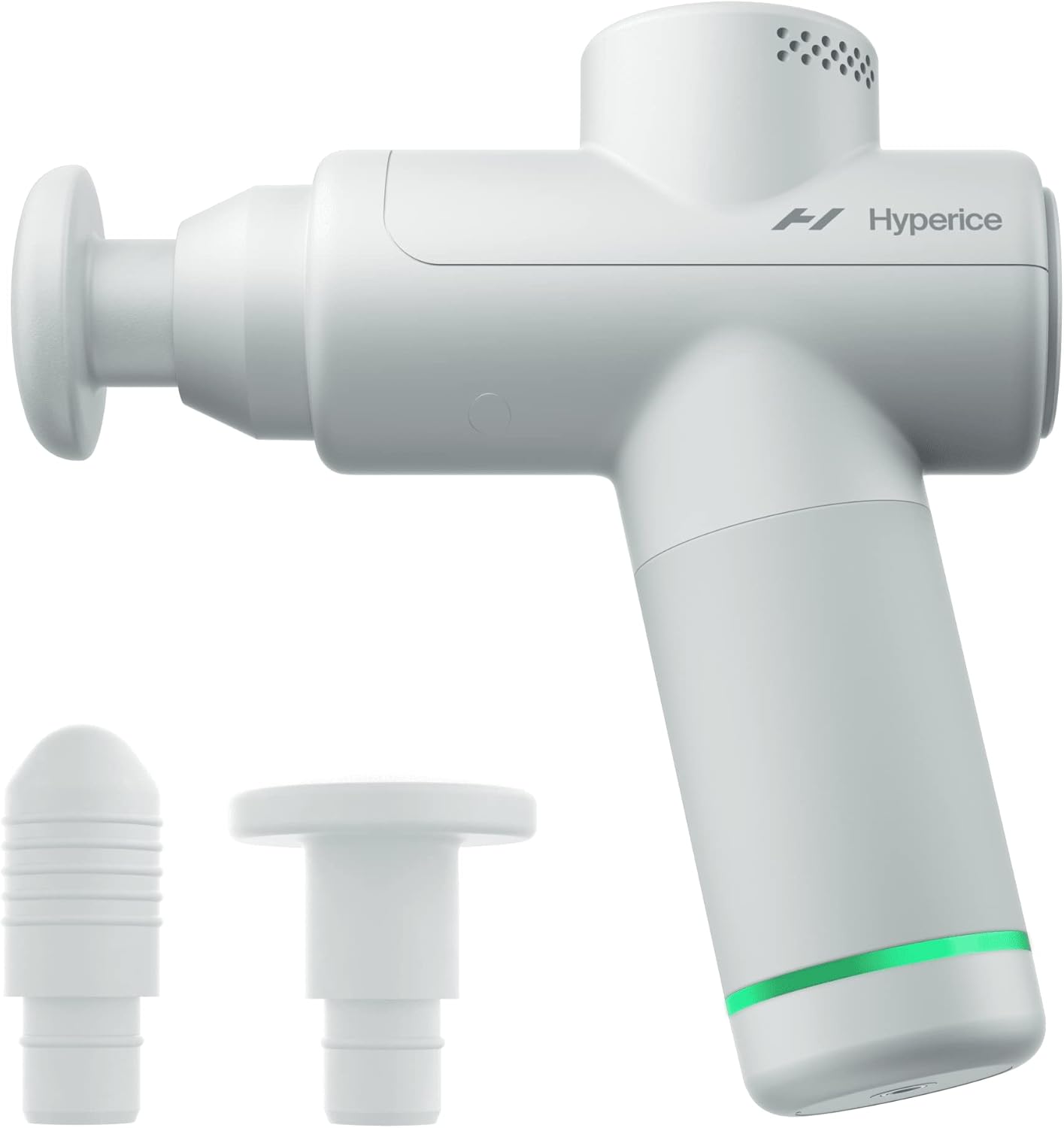
Stiff calves and tight hamstrings directly compromise your stride length and heel strike mechanics. The Hyperice Hypervolt Go 2 provides targeted percussion therapy to flush out lactic acid and keep your lower limbs limber before and after workouts.
Weighing only 1.5 pounds, we found this massager exceptionally easy to pack in a gym bag. Despite its compact footprint, the brushless motor packs three powerful speed settings that punch deep into tight calf muscles.
Hyperice Hypervolt Go 2
- Key Advantage: Ultra-portable percussion therapy with TSA-approved travel design.
- Specifications: Weighs 1.5 lbs, 3 speed levels, 3-hour battery life per charge.
- Warranty / Support: 1-year manufacturer warranty.
What We Liked
- Featherlight build makes it easy to hold during long sessions
- Remarkably quiet motor operation
Things to Consider
- Fewer attachment heads included compared to full-sized models
How to Choose the Best Running Form Gear for Your Needs
Investing in running form upgrades requires analyzing where your technique breaks down. If you suffer from slouching and forward-leaning posture, real-time biofeedback sensors like the Lumo Run or Garmin Pod will offer the highest ROI.
If your form issues stem from muscle tightness and restricted range of motion, prioritize mobility and recovery tools like the TriggerPoint foam roller and Hyperice massage gun. Always match your gear selection to your specific biomechanical weaknesses.
💡 Pro Buying Tip: Avoid buying heavy wearable weights for running, as adding load to your extremities alters your natural gait and increases injury risk. Stick to using lightweight resistance bands strictly for pre-run activation drills.


